
SSDI Eligibility Explained: Do You Qualify for Disability Benefits?

Before anything else, most people asking about SSDI just want a straight answer to one question: do I actually qualify? It is a fair question, and it deserves a clear one in return. SSDI eligibility comes down to two separate tests, one about your work history and one about your medical condition, and you have to meet both.


The Two-Part SSDI Eligibility Test

First, the SSA checks whether you have worked enough, and recently enough, to have paid into the system through Social Security taxes. Second, it evaluates whether your medical condition meets its definition of disability. Meeting only one of these is not enough. Both have to be true.


How Many Work Credits Do You Need?

Most adults need 40 work credits to qualify for SSDI, with at least 20 of those earned in the ten years immediately before you became disabled. Younger workers who become disabled before accumulating a full work history typically need fewer credits, on a sliding scale based on age. If you are unsure whether your specific work history meets this threshold, a free evaluation is the fastest way to find out with certainty rather than guessing.


What Counts as a "Disability" Under SSA rules

The SSA's definition is stricter than most people expect. Your condition must prevent you from performing substantial gainful activity, and it must be expected to last at least twelve months or result in death. Temporary or short-term conditions, even serious ones, generally do not meet this threshold on their own.


The SSA's 5-Step Evaluation Process

Every SSDI claim moves through the same five questions, in order:

Are you currently working above the substantial gainful activity limit? If so, you generally cannot be found disabled, regardless of your medical condition.


Is your condition "severe"? It must significantly limit your ability to perform basic work activities.


Does your condition meet or equal a listed impairment? The SSA maintains a list of conditions considered automatically severe enough to qualify, if fully documented.


Can you still perform your past work? If your condition prevents you from doing the work you did before, the evaluation continues.


Can you adjust to other work? Considering your age, education, and transferable skills, the SSA decides whether any other substantial work is realistically available to you.


Reaching a favorable answer at any of these steps can result in approval, which is exactly why thorough documentation at every stage matters so much.


Can You Qualify If You've Never Worked?

Not for SSDI specifically, since it requires work credits earned through payroll taxes. However, SSI is a separate, needs-based program that does not require a work history at all, based instead on income and resources.


Understanding which program actually fits your situation is the subject of our full breakdown of SSI versus SSDI, and it is worth reading before you apply for the wrong one.


The fastest way to get a clear answer about your own situation is a free evaluation, no guesswork required.


Frequently Asked Questions


What are the basic eligibility requirements for SSDI?

You must have earned enough work credits through Social Security-taxed employment, and have a medical condition that prevents substantial work and is expected to last at least twelve months or result in death.


How many work credits do I need to qualify for SSDI?

Most adults need 40 credits, with 20 earned in the last ten years before becoming disabled. Younger workers may qualify with fewer credits based on their age.


Can I qualify for SSDI if I've never worked?

No, SSDI requires work credits earned through payroll taxes. SSI, a separate needs-based program, does not require a work history and may be the right option instead.


What medical conditions automatically qualify for disability?

The SSA maintains a list of conditions ("the Listings") considered severe enough to qualify automatically when fully documented, though many claimants without a listed condition still qualify by demonstrating their functional limitations prevent all substantial work.


What is the SSA's 5-step evaluation process for SSDI?

It checks whether you're working above the substantial gainful activity limit, whether your condition is severe, whether it meets a listed impairment, whether you can do your past work, and finally whether you can adjust to any other type of work.


August 25, 2026
SSDI back pay guide banner with students examining a specimen under a microscope with their teacher
By Carpe Diem August 17, 2026
Approved for SSDI? Here's how back pay is actually calculated, how far back it goes, when you'll receive it, and whether it's taxed.
Do you need a lawyer for SSDI, disability representative vs attorney explained by Disability Advisor
By Carpe Diem August 10, 2026
Wondering if you need a disability lawyer for SSDI? Learn the real difference between an attorney and a qualified representative, and what each costs.
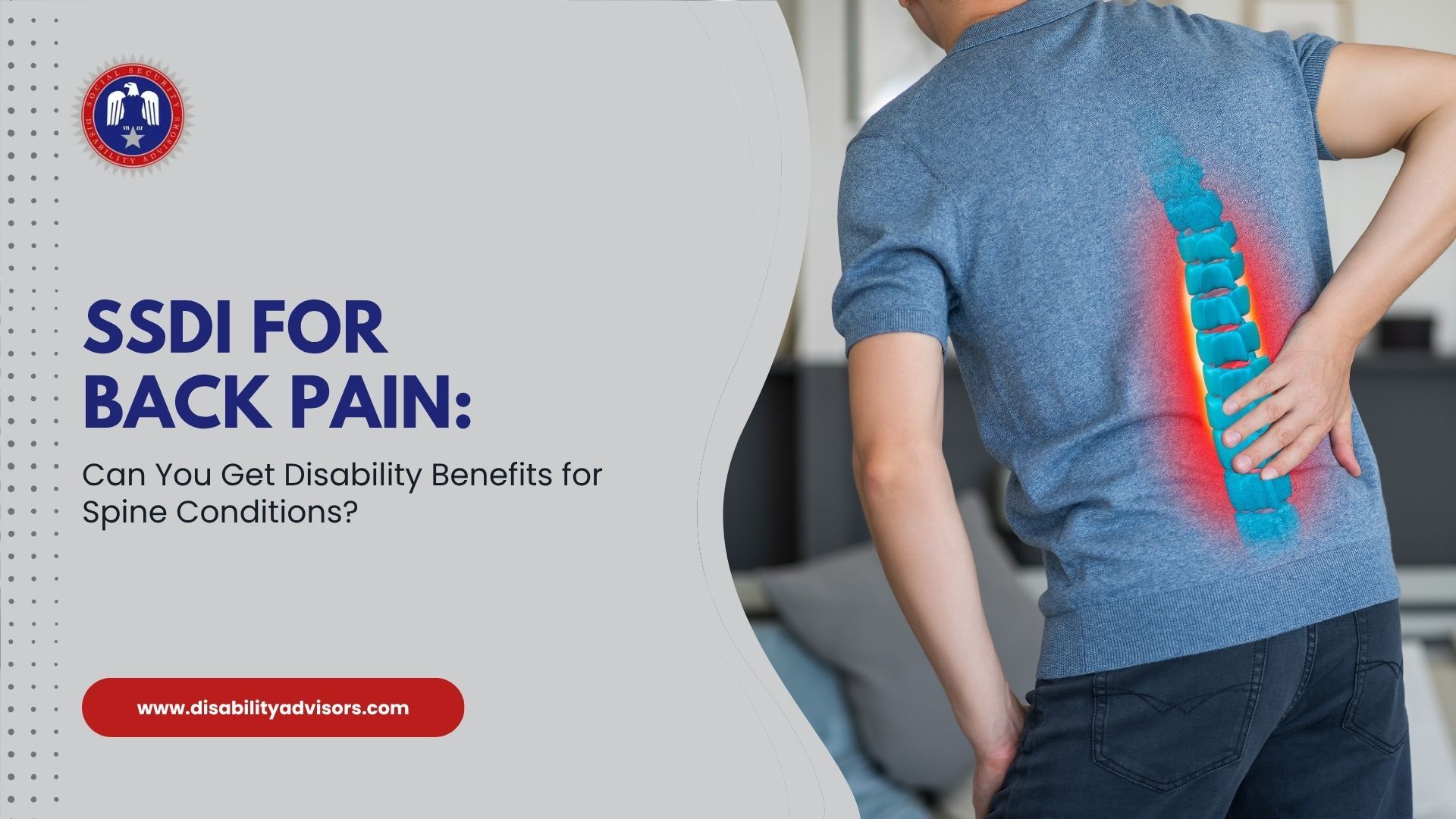
Man holding lower back with spine highlighted, illustrating SSDI benefits for spine conditions
By Carpe Diem August 4, 2026
Living with chronic back pain? Learn what medical evidence you need to qualify for SSDI with spinal stenosis, herniated discs, or degenerative disc disease.
SSDI for mental health conditions depression anxiety PTSD guide | Social Security Disability Advisor
By Carpe Diem July 28, 2026
Struggling with depression, anxiety, or PTSD? Learn how SSDI works, what evidence helps you qualify, and get a free case evaluation. No fee unless you win.
How to appeal a denied SSDI claim guide, Social Security Disability Advisors 2026
By Carpe Diem July 21, 2026
Got denied for SSDI? You still have options. Learn the appeal steps, deadlines, and how to strengthen your case. Free evaluation, no fee unless you win.
Disability advisor consulting with client in wheelchair about top 10 reasons SSDI claims are denied
By Carpe Diem July 17, 2026
Learn the top reasons SSDI is denied in 2026, how to avoid costly mistakes, and what to do if your SSDI claim is denied. Get expert guidance today.
SSDI approval timeline 2026 guide consultation with Social Security Disability Advisors
By Carpe Diem July 13, 2026
See the real SSDI approval timeline for 2026, stage by stage. Learn what speeds up your case and what causes delays. Free evaluation, no fee unless you win.
By Carpe Diem July 8, 2026
You know you cannot work. You know you need help. But Social Security keeps throwing terms at you, and you are not sure which program you even qualify for. SSI vs SSDI is one of the most confusing points in the entire Social Security Disability system. Both programs pay monthly disability benefits. Both are run by the Social Security Administration. But they have completely different eligibility rules, payment amounts, and application requirements. Applying for the wrong one, or applying without understanding the difference, is a mistake that costs applicants months of lost time and benefits. Social Security Disability Advisors (SSDA) has helped thousands of disabled adults across Salt Lake City, Ogden, Provo, Holladay, Millcreek, and nationwide understand exactly which program fits their situation, and how to build a claim that wins. This guide gives you the clear, direct answers SSA never explains upfront. Key Takeaways SSDI is based on your work history and the Social Security taxes you paid over your career SSI is a needs-based program with no work history requirement, but strict income and asset limits apply You may qualify for both programs at the same time, known as concurrent benefits SSDI typically pays more than SSI, but SSI serves those who have never worked or have limited credits SSDA provides free evaluations for both programs, with no fee unless you win your case Utah residents in Salt Lake City, Ogden, Provo, and beyond can access both local and nationwide SSDA support In this article What is SSI and who qualifies SSI vs SSDI: side-by-side comparison Can you receive both SSI and SSDI at the same time Which program should you apply for How SSDA helps you choose and win Frequently asked questions What Is SSDI and Who Qualifies? SSDI stands for Social Security Disability Insurance. It is a federal insurance program you pay into every time Social Security taxes are withheld from your paycheck. When a medical condition prevents you from working, SSDI pays you a monthly benefit based on your lifetime earnings record. SSDI is not welfare. It is a benefit you earned through years of work. That distinction matters both emotionally and legally, because SSA evaluates your work history as a core part of your disability eligibility . SSDI Eligibility Requirements for 2026 To qualify for SSDI, you must meet two separate tests. The first is a medical test: your physical or mental condition must prevent you from performing any substantial work and must be expected to last at least 12 months or result in death. The second is a work credits test: you must have earned enough Social Security credits through paid employment.
Closeup of a clipboard with a form that reads: Social Security Disability Claim
March 3, 2026
Learn how Social Security Disability works in Utah, from the SSDI application process to appeals and ALJ hearings, and understand what improves approval chances.
Person applying for Social Security Disability benefits with help from disability advisors
By Jonathan Tingey September 3, 2025
Learn how to make parent-teacher conferences positive and productive with helpful tips that encourage collaboration, communication, and student success.